
A round baler is rarely a small purchase. For most operations, it is the single most expensive piece of equipment in the haymaking chain — and the wrong choice tends to cost you twice: once at purchase, then again every season for the rest of the machine’s life through poor bale quality, lost throughput, and spare parts you can’t get hold of.
This guide is written for international buyers — dairy, beef, hay-export and contracting operations that need to make a sound capital decision without standing in a dealership for three weekends. We focus on the seven specifications that genuinely separate balers in the field, including a few that brochures tend to bury near the back.
If you only have ten minutes, jump to the buyer’s checklist at the end.
Before you look at any baler: get three numbers right
Almost every regret we hear from importers traces back to one of the same three mismatches. Sort these out before you compare brands or models:
- Annual bale count. A small operation putting up 800–1,500 round bales a year has very different needs from a contractor pushing 8,000–12,000. Heavy-duty professional balers are over-engineered (and over-priced) for hobby acreage, and entry-level balers will not survive a contractor’s season.
- Crop mix. Dry hay, wet silage, straw, cornstalks and stover all behave differently inside a chamber. A baler optimised for dry alfalfa is not the right machine for heavy maize silage at 60% moisture.
- Tractor on hand. Your existing tractor — its PTO horsepower, hydraulic flow, hitch type, and gross weight — sets a hard ceiling on what you can usefully run. We come back to this in Spec 5.
With those numbers in mind, here are the specifications that matter.
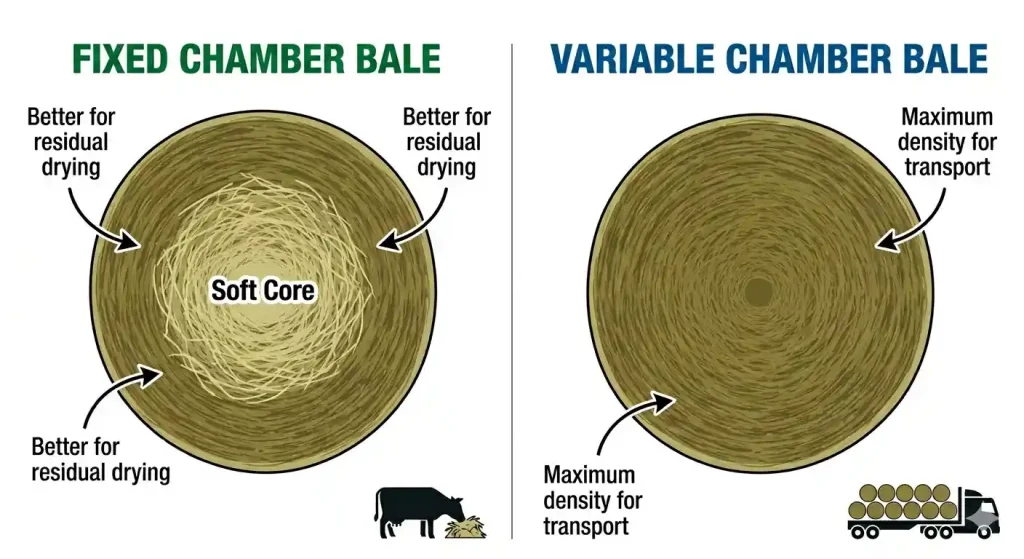
Spec 1: Bale chamber type — fixed vs. variable
The chamber type is the most fundamental design choice on a round baler, and it shapes nearly every other behaviour of the machine.
Fixed chamber balers
A fixed chamber baler has a chamber of constant size, usually defined by a ring of rollers, chains-and-slats, or short belts. Hay rolls inside until the chamber fills. The result is a bale with a soft core and a denser outer shell.
Best for:
- Dry hay where a soft core helps residual drying continue inside the bale
- Silage and haylage operations, where the soft core is forgiving on damp material
- Operators wanting a simpler, lower-maintenance machine
Trade-offs: Bale size is not adjustable. Density is generally lower than a comparable variable chamber baler.
Variable chamber balers
A variable chamber baler uses long belts (or a combination of belts and rollers) that expand outward as the bale grows. Density is consistent from core to outer shell, and the operator can dial in bale diameter to suit handling equipment.
Best for:
- Dry hay sold by weight (denser bales = more tonnes per bale)
- Mixed crop seasons where bale size needs to vary by market or transport
- Any operation transporting bales over long distances — denser bales reduce freight cost per kilogram
Trade-offs: More belts mean more wear parts and more attention to belt tracking. Slightly more sensitive to short, light material.
A third category, combination “semi-variable” balers, splits the difference and is increasingly common — see your shortlist for whether the model uses true variable belts or a hybrid system.
Internal link: For a deeper comparison of these two designs, including cost-of-ownership numbers, see our article Fixed Chamber vs. Variable Chamber Round Baler.
Spec 2: Bale size and density
Bale dimensions look like a marketing detail. They are not — they directly determine how many bales fit on a truck, how your loader handles them, and what your storage barn can hold.
Common round bale sizes worldwide:
| Bale size (Ø × W) | Approximate weight (dry hay) | Typical use |
|---|---|---|
| 4 ft × 4 ft (1.2 × 1.2 m) | 250–350 kg | Small farms, hobby operations |
| 4 ft × 5 ft (1.2 × 1.5 m) | 350–500 kg | Mid-size dairy / beef |
| 5 ft × 6 ft (1.5 × 1.8 m) | 500–800 kg | Commercial hay, contractors |
| 5 ft × 5 ft (1.5 × 1.5 m) | 450–650 kg | Common in Europe / Asia |
Note that silage bales of the same dimensions weigh roughly 50–70% more than dry hay because of moisture content.
Density is harder to read off a spec sheet but matters more than size for transport economics. Densities of 180–250 kg/m³ are typical; premium variable chamber machines can push higher in good crop. If you are exporting hay, ask the supplier for a real-world density figure on your specific crop, not a peak laboratory number.
A simple test for any baler on a demo day: ask the operator to thump a finished bale with the side of a fist. A hollow sound usually means under-density; a solid, dull thud is what you want.
Spec 3: Pickup width and tine configuration
The pickup is the front end of the baler that lifts hay off the windrow. A pickup that is too narrow leaves crop in the field; one that is too wide for your windrows wastes capital. The right pickup matches the widest windrow your rake produces.
Pickup width
Common pickup widths:
- 1.6–1.8 m — entry-level / mini balers
- 1.8–2.0 m — most mid-size farm balers
- 2.0–2.2 m — high-capacity professional balers
- 2.4 m+ — dedicated contractor machines
Match the pickup to the maximum windrow width your rake will produce. If your rotary rake makes a 1.5 m windrow but your pickup is 2.2 m, the wider pickup buys you very little — you’ve paid for capacity you can’t feed.
Tine bars and tine spacing
More tine bars (typically 4 to 5) and closer tine spacing means cleaner pickup, less leaf and seed loss, and better performance in short or thin crop. A 5-bar pickup with closer tine spacing is the gold standard for premium hay markets where every leaf matters.
For abrasive crops (wheat straw, cornstalks, stover) check whether the tines and pickup bands are field-replaceable as service items. They wear faster than most operators expect.
Roller windguards
A roller windguard sits ahead of the pickup and holds the windrow down while it feeds in. For thick or heavy crop, a windguard noticeably improves throughput. For light, dry hay, the difference is smaller — though the windguard helps keep loose material out of the air.
Spec 4: Tying system — net wrap, twine, or both
The tying system has three impacts: bale appearance, weather resistance, and how much time you lose at the end of every bale.
Twine tying
Twine has been the haymaker’s standard for decades. It is cheaper per bale than net wrap, mechanically simpler, and well-suited to bales that will be fed soon after baling.
Trade-offs:
- Slower wrap cycle — typically 15–25 seconds per bale, depending on revs and density
- Less weather protection on stored bales
- More risk of bird and rodent damage on the surface
Net wrap tying
Net wrap covers the bale circumference in 1.5 to 3 wraps in just a few seconds. It produces a tighter, more cylindrical bale that sheds water better and looks more presentable for sale.
Trade-offs:
- Higher per-bale consumable cost (typically 2–3× twine)
- Net wrap is a plastic waste stream — relevant for some markets and certifications
Industry research suggests outdoor-stored bales wrapped in UV-stabilised net or plastic film can cut dry matter loss to single digits, against losses of 30%+ for unwrapped bales left on bare ground.
Combination machines
The best machines offer both twine and net wrap as a switchable system, letting the operator pick the right tie for the bale. For commercial hay operations that sell into different channels (wholesale vs. retail vs. export), a combination tying system pays for itself within a season.
Internal link: Net Wrap vs. Twine Tying System: Which One Should Your Baler Have?
Spec 5: Tractor HP requirements and hitch type
This is where buyers make their most expensive sizing mistake — and where suppliers, frankly, are not always candid.
PTO horsepower minimums
A reliable rule of thumb (PTO horsepower at 540 or 1000 RPM):
| Bale size | Minimum PTO HP | Comfortable PTO HP |
|---|---|---|
| 4 × 4 / 4 × 5 | 40–50 HP | 60–70 HP |
| 5 × 5 | 60–70 HP | 80–90 HP |
| 5 × 6 with cutter / pre-chamber | 90–110 HP | 110–130 HP |
| Heavy silage chamber, professional class | 120–150 HP | 150 HP+ |
Note that “minimum” is for dry, light hay in a flat field. As soon as crop is heavy, wet, or you’re working hilly ground, you need to be operating at the comfortable end of the range, not the minimum.
Tractor weight matters as much as horsepower
A round baler with a finished 600 kg bale on its tongue, on a 5° slope, will quickly tell you whether your tractor is heavy enough. The general principle: the tractor’s gross weight should exceed the loaded baler’s gross weight, especially on hilly terrain. Light tractors with heavy balers behind them are an extension brake-failure waiting to happen.
Hitch type
Most balers attach to a drawbar with a hitch pin (Cat. I, II or III sizing depends on baler weight). For larger balers, ensure your tractor’s drawbar load rating actually accepts the baler’s vertical load. Mismatched hitches are a common dealer “extra” that gets quoted only after the contract is signed.
Hydraulics and electrics
Most balers need at least one double-acting remote for tailgate operation. Premium balers with cutter activation, density control, and ISOBUS monitors need more. Verify your tractor has the remotes (and ISOBUS plug if applicable) before you commit.
Internal link: Tractor HP Requirements for Round Balers: 40 HP, 80 HP, 100 HP+ Sizing Guide
Spec 6: Crop adaptability — hay, silage, straw, stover
A baler that performs well on dry alfalfa might choke on wet maize silage, and vice versa. International buyers regularly underestimate this — particularly when their operation runs more than one crop per year.
Dry hay (10–18% moisture)
Most balers handle this happily. Look at pickup quality, leaf retention, and bale shape consistency. For premium hay markets (export-grade lucerne, oaten hay), leaf retention is the #1 quality metric and a 5-bar pickup with low tine wear is what gets you there.
Silage and haylage (40–65% moisture)
Wet, heavy material puts extra load on every part of the baler. You want:
- Heavy-duty roller chamber or reinforced belt design
- Larger bearings and beefier driveline
- Often a cutter / chopper rotor at the pickup to reduce particle length
- A baler-wrapper combination, or a separate wrapper, downstream
If silage is more than 30% of your annual bale count, look at silage-rated machines, not dry-hay machines with a “silage option.”
Straw and stover (very dry, abrasive)
Cereal straw and corn stover are abrasive and dusty. They wear pickup tines, belts, and rollers faster than hay. Look at:
- Replaceable, hardened pickup tines
- Belt material rated for straw (synthetic-rubber compound matters)
- Easy access for cleaning — straw chaff loves to pack into corners
Mixed-use operations
If you genuinely run mixed crops, prioritise build quality and serviceability over crop-specific optimisations. A robust mid-range baler that handles all three crops at 80% efficiency beats a specialised machine that’s perfect for one crop and frustrating in the other two.
Spec 7: Service availability and spare parts — the spec everyone underweights
This is the section that international buyers wish they’d read more carefully. A baler is a long-term relationship with whoever sold it to you. If parts are six weeks away, your baler is six weeks away from working. Ask these questions before you sign:
Parts catalogue and lead times
- Is there a published parts catalogue with diagrams and part numbers?
- What is the typical lead time for wear parts (belts, tines, rollers, cutters)?
- What about major components (gearboxes, hydraulic cylinders, electronics)?
- Is there a regional spare parts depot, or does everything ship from origin?
Operator manual and technical documentation
Demand a complete operator manual in your team’s working language, plus a service / parts manual if at all possible. Walk through the lubrication schedule with the supplier and confirm grease-fitting accessibility — some balers have grease points that require partial disassembly to reach.
Technical support
What does support look like once the machine is on your farm? Email-only support across time zones is much less useful than 24/7 phone or video support that can talk an operator through a field breakdown at 5 AM during peak season.
Warranty terms
Standard warranties run 12 months. Some manufacturers offer 24 months on structural components. Read the wear-parts exclusion list carefully — some warranties exclude all “consumables,” which a creative supplier can interpret broadly.
Common mistakes international buyers make
After dealing with hundreds of international round baler purchases, these are the patterns we see most often:
- Buying for last year’s crop. Specifying a machine based on a season that turned out abnormally light or heavy. Use a 3-year average.
- Ignoring tractor compatibility until delivery. Find out at delivery that you need a different drawbar or extra hydraulic remotes.
- Optimising for purchase price over total cost of ownership. A 20% cheaper baler that uses 40% more belts and breaks down twice a season is not a saving.
- Underestimating spare parts logistics. Especially for buyers in regions where ocean freight from origin is 6+ weeks. Always ask whether a regional spare parts buffer is available.
- Skipping the field demo. If you cannot demo the actual model, ask for a field video on a comparable crop. Brochures are marketing; field video is data.
- Taking “compatible with all tractors” at face value. Always verify with your tractor’s spec sheet, not the salesperson’s word.
Buyer’s checklist (use this before you sign)
| # | Question | Confirmed? |
|---|---|---|
| 1 | Annual bale count, crop mix and farm size documented | ☐ |
| 2 | Tractor PTO HP, weight and hydraulics verified against baler | ☐ |
| 3 | Chamber type (fixed / variable) chosen and justified | ☐ |
| 4 | Bale size matches storage and handling equipment | ☐ |
| 5 | Pickup width sized to widest windrow | ☐ |
| 6 | Tying system (twine / net / both) chosen | ☐ |
| 7 | Crop-specific options confirmed (cutter, silage upgrade, etc.) | ☐ |
| 8 | Parts catalogue and lead times documented | ☐ |
| 9 | Operator manual in working language confirmed | ☐ |
| 10 | Warranty terms and wear-part exclusions read | ☐ |
| 11 | Technical support channels and response times confirmed | ☐ |
| 12 | Field video or demo of comparable operation reviewed | ☐ |
If you cannot tick all twelve before placing an order, you are buying a baler on hope. Wait, ask, and verify.
Frequently asked questions
Q: What is the minimum tractor HP for a round baler?
A: For a basic 4 × 4 fixed chamber baler, 40–50 PTO HP is workable. For a 5 × 6 variable chamber baler with a cutter rotor, plan on 110+ PTO HP for comfortable operation.
Q: Are net wrap balers worth the extra cost over twine?
A: For commercial hay, almost always yes. For occasional hobby use where bales are fed soon after baling, twine is fine.
Q: How long should a quality round baler last?
A: A well-maintained mid-range baler should serve 8,000–15,000 bales without major component replacement. Premium professional machines can exceed 30,000 bales.
Q: Can one baler do both dry hay and silage well?
A: Mid-range balers handle both reasonably; specialist silage balers are noticeably better at wet material. If silage is more than 30% of your output, buy a silage-rated machine.
Q: What’s the most common reason new operators ruin a baler?
A: Running it too fast in heavy crop, then trying to clear plugs without disengaging the PTO. Both lead to driveline damage and serious safety risk.
Next step
Choosing a round baler is a multi-month decision. The work is not in finding a baler — it is in matching the right baler to your tractor, your crop, your storage, and your service realities.
Browse our Siri Baler Bulat to see options across fixed-chamber, variable-chamber and mini round baler categories. Each product page includes complete specifications, tractor compatibility data, and standard / optional configurations. If you’d like a written recommendation against your specific operation, contact our technical team — we’ll review your requirements and respond with a shortlist within 24 hours.
About the author: This guide was written by the technical team at Australia baler-hay Co., Ltd, an international supplier of haymaking equipment with 24/7 support for export buyers across Asia, the Middle East, Africa, and Europe.