
Australia is one of the world’s most important hay-producing nations — a serious player in global export markets despite a relatively small population, and a country whose hay growers have learned to operate across some of the most variable climates of any agricultural producer. From the irrigated lucerne flats of the Riverina to the dryland oaten hay belts of Western Australia, Australian haymaking is shaped by extremes: long droughts, intense heat, occasional floods, and bushfire risk that defines the operational calendar.
This article gives an overview of the Australian hay industry — its regions, its crops, its export markets, and the equipment considerations that matter when haymaking in Australian conditions. Whether you’re an Australian grower benchmarking against the wider industry, or an international buyer looking at why Australian hay practices have influenced global haymaking, this is your starting point.
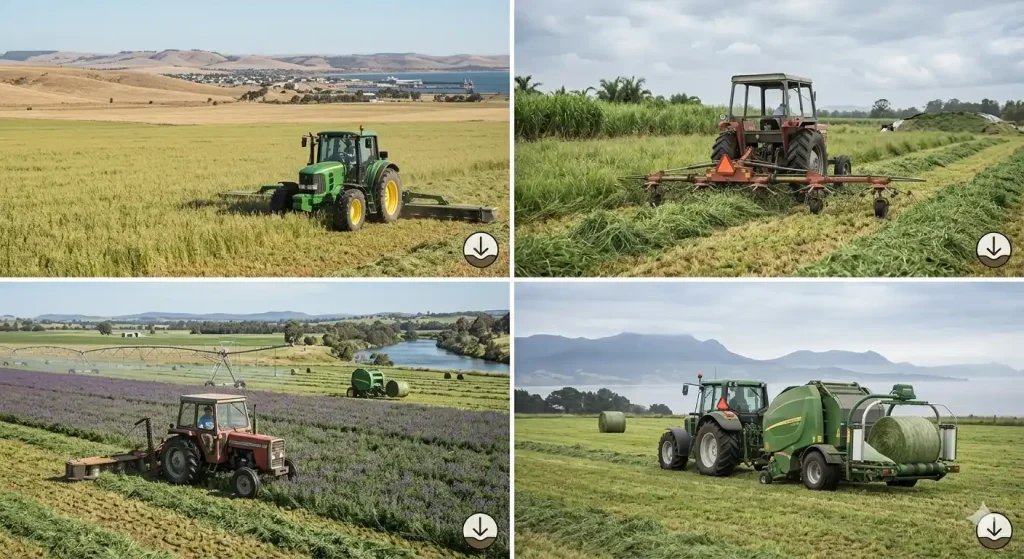
Australia’s place in the global hay market
Australia is one of the world’s largest exporters of premium oaten hay and a major exporter of lucerne. Most of the export trade goes to:
- Japan — historically the largest single export market, primarily for dairy and beef
- South Korea — significant and growing demand for premium oaten hay
- China — a major buyer of Australian lucerne and oaten hay for dairy
- Saudi Arabia and the UAE — high-value buyers of premium hay for elite horse and dairy operations
- Taiwan, Vietnam, Indonesia — smaller but growing buyers for dairy and beef
Domestic demand is dominated by the dairy and beef sectors, plus the horse industry, plus periodic spikes during drought years when ruminant feed becomes scarce.
For producers, the export trade is significant because export markets pay premium prices for visual quality, low ash content, low foreign material, and consistent leaf retention — factors that directly drive equipment choices on Australian farms. A mower or rake decision on a high-export-value operation is a quality decision, not just an economics decision.
Major hay-producing regions
Australia’s hay industry is concentrated in a few specific regions, each with its own climate, dominant crops, and equipment patterns.
Western Australia: the oaten hay heartland
The wheat belt and southern coastal regions of WA produce a very large share of Australia’s export oaten hay. The combination of mild winters, warm dry summers, and reliable harvest weather makes WA almost ideal for premium oaten hay production. Major production zones include the Esperance region, the south coast, and parts of the central wheat belt.
WA-grown oaten hay sets the global benchmark for export quality. The export trade has driven adoption of modern disc mower-conditioners, rotary and twin bar rakes, and high-capacity round and large square balers across the region.
South Australia: lucerne and oaten
The Riverland, Mid-North, and parts of the Eyre Peninsula produce significant lucerne and oaten hay. Irrigation along the Murray supports intensive lucerne operations producing multiple cuts per year. Dryland oaten hay is also significant, especially in the Mid-North.
Victoria: dairy hay and silage
Victoria’s dairy industry — particularly the Goulburn Valley, Western District, and Gippsland — drives substantial demand for haylage, silage, and dairy-grade hay. Equipment lineups in dairy regions tend to be silage-capable: mower-conditioners, rotary rakes, and silage-rated round balers paired with bale wrappers are the norm.
New South Wales: mixed grain-and-livestock and lucerne
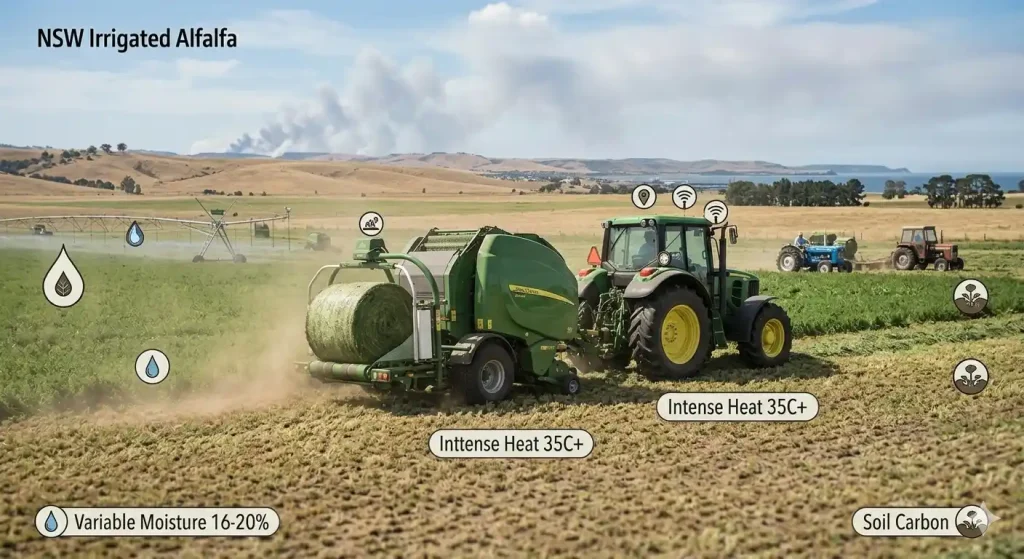
The Riverina, southern slopes, and northern plains all produce hay, with crop mix varying by zone. Irrigated lucerne flats around Hay, Griffith, and Leeton are some of the most productive lucerne regions in the country. Mixed grain-and-livestock operations across the wheat belt produce oaten hay as part of a broader rotation.
Queensland: tropical and subtropical haymaking
Queensland’s hay industry is more diverse and weather-challenged than southern states. Tropical grasses (Rhodes grass, panic grasses), forage sorghum and maize silage are common. The combination of summer storms, high humidity, and short drying windows makes equipment selection in Queensland particularly demanding — mower-conditioners and silage-capable balers are widely used.
Tasmania: small but high-quality
Tasmania’s smaller hay industry is dominated by dairy and beef demand, with lucerne, ryegrass and clover hay common. The cooler, wetter climate means tedding and silage equipment are particularly important.
The major Australian hay crops
Oaten hay
The export flagship of the Australian hay industry. Oats sown in autumn, grown over winter, and cut in spring at the soft-dough stage produce hay with excellent feed value, attractive colour and consistent leaf retention. Premium-grade export oaten hay sells into Japan and Korea at high prices.
Equipment considerations: leaf retention is paramount. Disc mower-conditioners with proper conditioning settings, gentle rotary or twin bar rakes, and round balers with 5-bar pickups dominate premium oaten hay operations.
Lucerne (alfalfa)
The world’s most important high-protein forage. Australian lucerne is produced in irrigated systems along the Murray and Darling rivers, in dryland operations in mediterranean climates, and as a smaller component on dairy farms across the south.
Lucerne is cut multiple times per season (typically 4–8 cuts on irrigated systems). Leaf is the most valuable part — and also the most fragile. Leaf loss during raking and baling is the dominant quality risk.
Equipment considerations: gentle rake action, careful baler pickup adjustment, and baling at correct moisture (16–20% for round bales) all matter. Sun-bleached or rain-damaged lucerne loses substantial value.
Ryegrass and grass hay
Common in dairy regions across Victoria, Tasmania, and southern NSW. Often cut as silage rather than dry hay. Mixed sward operations (ryegrass + clover) dominate dairy fodder production.
Vetch hay and pulse hays
Common in some grain-belt regions as a rotation crop with hay value. Vetch hay has a distinctive flavour and is valued in some specialty markets.
Forage sorghum and maize silage
Common in subtropical and warmer regions, particularly Queensland and northern NSW. These are typically harvested as silage rather than dry hay, requiring forage harvesters and silage handling equipment rather than the standard hay lineup.
Climate considerations for Australian haymaking
Australia’s climate creates several distinctive challenges for haymakers — challenges that shape equipment choices and operational practices in ways quite different from European or North American norms.
Drought and feed reserves
Drought is a recurring feature of Australian farming life, not an exception. Major droughts in recent decades have repeatedly driven hay prices to multiples of normal levels and stripped feed reserves nationally. This shapes Australian haymaking in two ways:
- Many beef and dairy operations carry substantial in-house hay reserves, baling more than current needs in good seasons to buffer drought years. This drives demand for high-throughput round balers and large-square balers that can rapidly process surplus crop.
- Hay storage discipline is taken seriously. Indoor storage, plastic-wrapped outdoor storage, and dense well-shaped bales are the standard, not the exception.
Heat and dust
Summer baling temperatures regularly exceed 35°C across much of inland Australia, with high dust loads in dry conditions. Equipment needs to tolerate heat and abrasion. Air filters, hydraulic cooling, and dust seals on bearings all see harder duty than in temperate climates.
Bushfire risk
Bushfire risk shapes the haymaking calendar and the storage of finished bales. Many districts impose total fire ban days during peak haymaking season — operators learn to start work in the cool of the morning and stop well before peak heat. Bale storage is typically separated from buildings and sheds where possible.
Variable rainfall and short drying windows
In northern districts and during transitional seasons, rainfall can interrupt drying. This pushes operators toward:
- Faster mowing capacity (so the entire field is cut before predicted rain)
- Mower-conditioners (to shorten drying time)
- Tedding (for the same reason)
- Silage capability (when dry hay isn’t possible)
Soil types and ash content
Much of southern Australia carries volcanic, sandy, or limestone-derived soils that are dust-prone. Wheel rakes — which drag tines along the ground — produce noticeably higher-ash hay in these soils than rotary or twin bar rakes. For premium export markets where ash content directly affects price, the rake choice matters more in Australian conditions than in some other regions.
Equipment considerations for Australian conditions
These themes recur across discussions with Australian haymakers and contractors:
Throughput is critical
Drying windows are short, fire bans punctuate the calendar, and rain can ruin a half-finished paddock. Australian operations typically buy more capacity than they think they need — wider mowers, faster rakes, higher-capacity balers. The “spare capacity” pays off in any season where weather goes sideways.
Conditioning is standard
Mower-conditioners are the dominant choice across commercial operations. The drying-time savings of conditioning directly addresses the rainfall risk that defines so many Australian haymaking decisions.
Density matters for transport
Australia is a large country with significant inland-to-port transport for export hay. Bale density directly affects per-tonne transport cost. Variable chamber round balers and large square balers (which produce denser bales) dominate commercial operations. For pure paddock-to-feedlot operations, fixed chamber balers remain common.
Ash content drives rake choice
Premium hay markets penalise high ash. Where soils are dust-prone, rotary or twin bar rakes pay back over wheel rakes within a few seasons through quality premiums.
Silage capability is increasingly common
Even on operations primarily focused on dry hay, silage-capable equipment (silage-rated balers, bale wrappers, forage harvesters) gives operators a fallback when weather makes dry hay impossible.
Spare parts logistics matter
Australia’s geographic scale means breaking down 4 hours from the nearest dealer is normal. Operators value brands with strong dealer networks, good parts availability, and proven field reliability. International buyers serving Australia learn quickly that selling a baler is easy; supporting it is what builds repeat business.
Industry resources and authority sources
For Australian growers wanting to dig deeper into hay production research and market data, the major reference sources are:
- MLA (Meat & Livestock Australia) — research on forage and feed for beef and lamb production
- Dairy Australia — silage, hay, and pasture research for the dairy sector
- GRDC (Grains Research and Development Corporation) — research on oaten hay and grain-side rotations
- AgriFutures Australia — specialty crops and emerging industries
- State Departments of Primary Industries — particularly NSW DPI and Agriculture Victoria publish detailed regional guides
- Feed Central, Hay Australia, AFIA (Australian Fodder Industry Association) — industry market data and pricing benchmarks
These are also the institutions that publish the underlying research most international agricultural extension services reference when discussing Australian best practice.
Looking ahead: trends shaping Australian hay production
Several trends are reshaping the industry over the medium term:
Climate variability driving feed reserve strategy. Operators are increasingly building deeper hay reserves than past generations, supported by improved baler throughput and storage practices.
Export market growth. Demand from Japan, Korea, China and the Middle East continues to support premium hay prices, though exposed to currency and trade dynamics.
Precision agriculture adoption. GPS-equipped tractors, moisture sensors integrated with balers, and yield mapping are becoming standard on larger operations.
Sustainability and carbon. Soil carbon programmes and emissions reporting are becoming relevant for some commercial operations, with implications for tillage, perennial-pasture choices, and feed-system design.
Generational change in equipment. Operations that have run older equipment through dry decades are upgrading as conditions improve. The mid-2020s are seeing significant capital investment cycles in new mowers, rakes and balers.
Frequently asked questions
Q: What is Australia’s biggest hay-producing region?
A: Western Australia is the largest single producer of export oaten hay. Other significant regions include the Riverina (NSW), Mid-North (SA), and Western District (Victoria), with crop mix varying by region.
Q: What is the difference between Australian oaten hay and lucerne hay?
A: Oaten hay is grass-family hay made from oat plants, prized in export markets for its consistent quality and feed value. Lucerne (also called alfalfa) is a legume hay with much higher protein content, used widely in dairy and elite horse markets.
Q: How much hay does Australia export?
A: Hay export volumes vary year-to-year with seasonal conditions but are consistently in the hundreds of thousands of tonnes annually, with export value typically in the high hundreds of millions of dollars. Industry data is published by AFIA and through ABS / ABARES export statistics.
Q: What’s the haymaking season in Australia?
A: It varies by region and crop. Oaten hay is typically cut in spring (October–November in southern regions, slightly later further south). Lucerne is cut multiple times per year on irrigation, typically October through April. Tropical grasses in Queensland have different cycles.
Q: Why is Australian hay so well-regarded in export markets?
A: A combination of consistent dry harvest weather across major production regions, strong industry quality standards, and good port logistics. Australian oaten hay in particular has built a reputation for visual quality and consistent feed value.
Next step
If you’re planning to grow your haymaking operation — whether you’re an Australian operator or an international buyer importing equipment — the key is matching the right machinery to your crop, your acreage, and your conditions.
Browse our complete range of haymaking equipment — round balers, mowers, hay rakes, bale trailers, bean lifters and forage processors — engineered for international conditions and supported by 24/7 technical service. Each product page includes complete specifications and tractor compatibility information.
For a deeper look at the haymaking workflow as a connected system, see our overview: The Complete Hay Equipment Workflow: Mower to Rake to Baler to Trailer Explained.
About the author: This guide was written by the technical team at Australia baler-hay Co., Ltd, an Australian-based supplier of haymaking equipment serving international export buyers with 24/7 technical support.